
.webp)


Lecture - Making the Invisible Visible: When a Tiny Crustacean Reveals the Secrets of Plastic Pollution
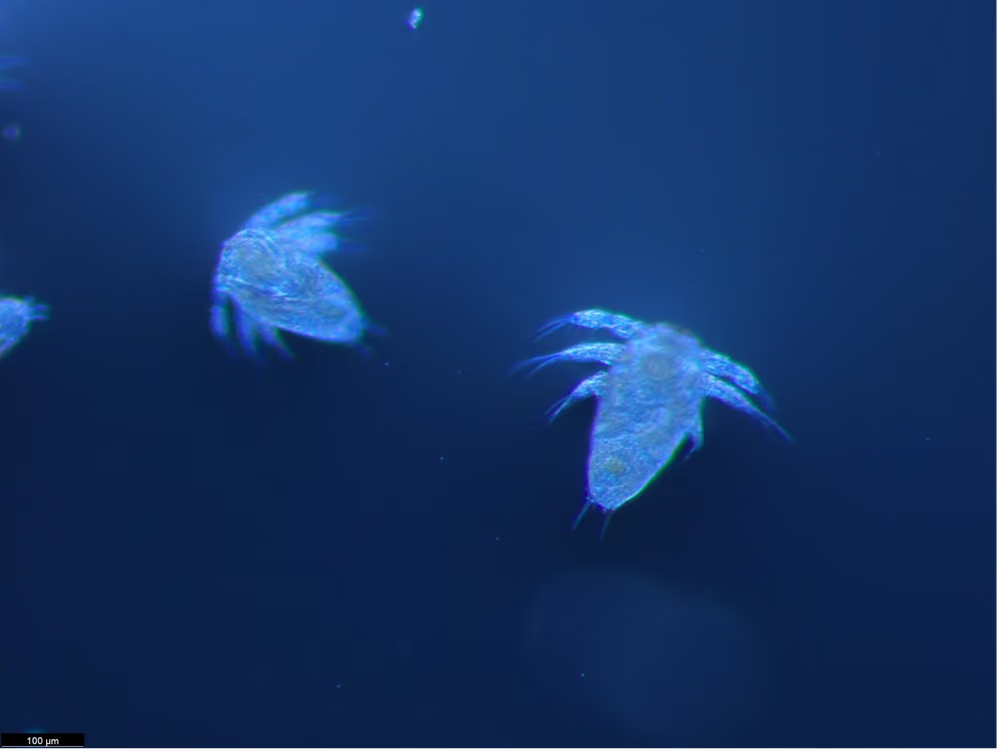
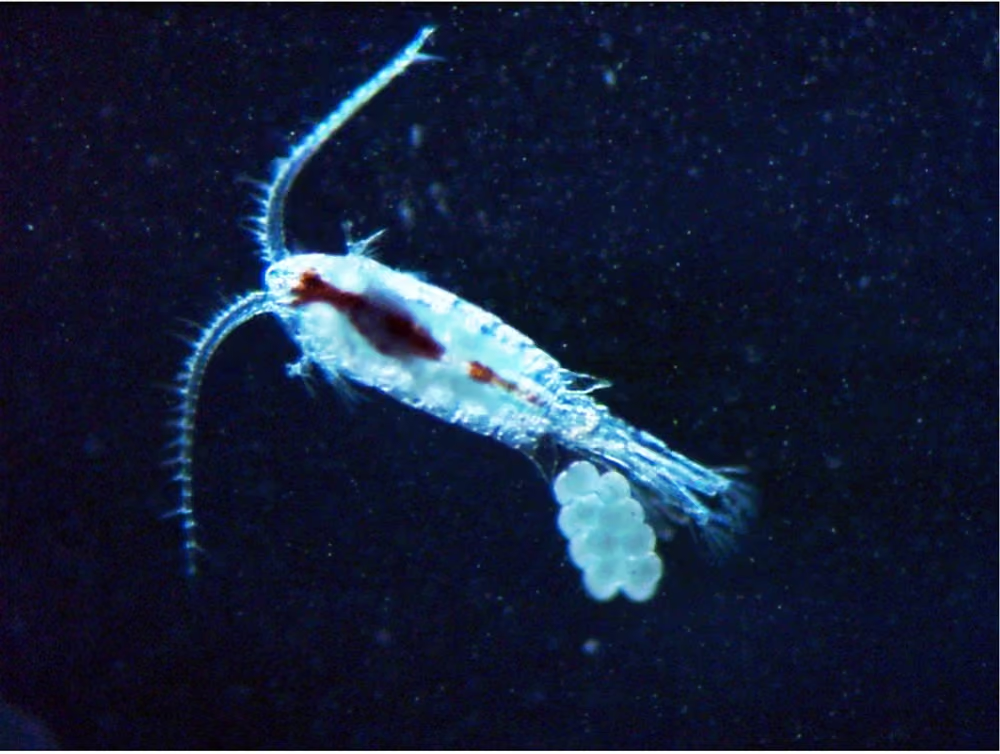
Microplastics are everywhere. Invisible to the naked eye, they travel from rivers to the sea, accumulate in estuaries, and make their way into the heart of living organisms. But how can we reveal what we cannot see? This talk offers a journey into the realm of the infinitely small, introducing a remarkable ally to researchers: Eurytemora affinis, a tiny crustacean barely a millimetre long. A true sentinel of estuaries, it allows scientists to decipher the effects of micro- and nanoplastics on ecosystems before their consequences even become visible.

Dates and times
Wednesday, October 7, 5:30 p.m. to 6:00 p.m.

Address
Quai de Marseille, Bassin de l'Eure
Through the Seine estuary, this exploration invites us to look differently at this land between earth and sea a crossroads of biodiversity, but also of pollution. It reveals how the invisible from plastic particles to the biological responses of living organisms is already shaping the living world.
At the meeting point of science and environment, this talk will show that understanding the infinitely small has become essential to preserving the immensely alive.
Summary of the ongoing research project: PLASTICOP
Plastic pollution is now one of the major environmental challenges. While visible waste on beaches or floating on the ocean surface draws attention, a large part of this pollution is invisible: microplastics and nanoplastics. Resulting from the breakdown of plastic objects, these tiny particles disperse throughout every compartment of the environment, particularly in estuaries those transitional zones between rivers and the sea.
The PLASTICOP research project focuses specifically on the estuaries of the Seine, in France, and the Saint Lawrence, in Quebec, where nano- and microplastics are now present in the water, the sediments, and living organisms. The aim is to better understand their fate and their effects on aquatic ecosystems. To this end, researchers are studying a small zooplankton crustacean, Eurytemora affinis, a species essential to the functioning of the food chain. As it feeds, this copepod can ingest nano- and microplastics, which may then be transferred to fish and other predators. The work will first seek to measure contamination in the two estuaries across the seasons. Laboratory experiments will then make it possible to assess the combined effects of microplastics and global warming on the development, growth, behaviour, and survival of juvenile copepods. The researchers will also aim to determine whether rising temperatures promote the accumulation of these particles within their organisms. Finally, comparing the French and Quebec populations will reveal whether they respond differently to these environmental pressures.
Beyond generating new scientific knowledge, this thesis will contribute to a better understanding of the consequences of plastic pollution on estuarine environments and aquatic biodiversity. It will also provide valuable information to improve the monitoring of these ecosystems and to anticipate the combined effects of human activities and climate change.
Summary of the project under evaluation: PLASTISENSE
PLASTISENSE is an interdisciplinary project that explores the impacts of micro- and nanoplastics on estuarine ecosystems by considering these particles no longer as mere contaminants, but as genuine ecological actors capable of altering the interactions between organisms. Beyond its scientific advances in ecotoxicology, microbiology, and evolutionary ecology, the project places society at the heart of its approach through an integrated framework of citizen science and science outreach. Citizens will be involved in collecting plastics along the Normandy coast, contributing directly to the production of knowledge on realistic environmental contamination. Students will also take part in the various stages of the project's dissemination, fostering exchanges between research, teaching, and society. Finally, art serves as a major lever for communication, translating scientific data from bio-imaging and genomics into visual and evocative experiences. This Art & Science approach will make an invisible pollution perceptible, harness emotion as a driver of understanding, and encourage citizens to take ownership of the issues surrounding microplastics. By combining cutting-edge research, artistic creation, and public participation, PLASTISENSE offers a new way of sharing scientific knowledge and strengthening the dialogue between researchers, citizens, and local communities.
Joëlle Forget-Leray
Joëlle Forget-Leray is a professor of ecotoxicology at the University of Le Havre Normandy, in the laboratory "Environmental Stress and Biomonitoring of Aquatic Environments," where she devotes her research to understanding aquatic ecosystems under environmental pressures. Through the study of copepods tiny crustaceans that act as sentinels of aquatic environments she develops innovative biomonitoring tools designed to better assess water quality and to support public environmental protection policies. A committed scientist, she combines academic excellence, the leadership of major national and European projects, and institutional responsibilities in the service of research. Convinced that science must engage in dialogue with society, she has been involved for many years in science outreach with citizens, schools, and decision-makers around the issues of pollution, climate change, and ocean preservation. Her career reflects a single ambition: to make research a driver of knowledge, action, and ecological transition.
Céleste Mouth
Céleste Mouth is a PhD student in ecotoxicology within the SEBIO laboratory at the University of Le Havre Normandy. Originally from Greece, she grew up by the Aegean Sea an environment that fostered her interest in aquatic ecosystems and their vulnerability to environmental change from an early age. Her research focuses on contamination by micro- and nanoplastics in two transatlantic estuaries, the Seine (France) and the Saint Lawrence (Quebec). She is particularly interested in the consequences of early-life and multigenerational exposure to these pollutants on the copepod Eurytemora affinis, a small crustacean that plays an important role in estuarine ecosystems.
