
.webp)


Subterranean Changes - An electro-acoustic concert by Ahmed Essyad and Gilles Aubry
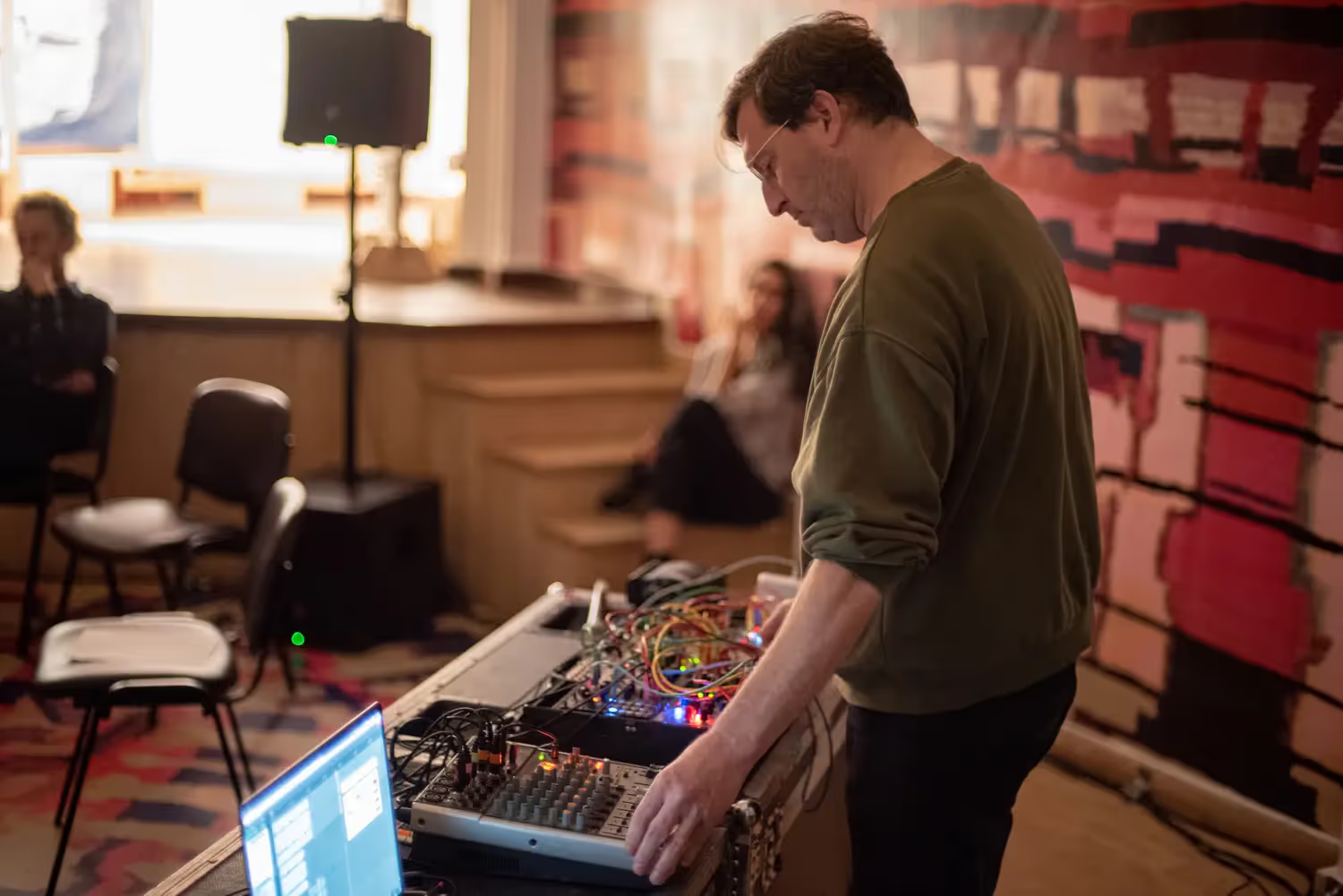
An electroacoustic concert by Ahmed Essyad and Gilles Aubry at the Salle Gérard Philipe, Institut Français de Rabat. The concert programme highlights the convergence of traditional and avant-garde music in Morocco. Ahmed Essyad's electronic compositions, dating from the 1970s, evoke the popular music heard in Moroccan villages in the late 1950s. Gilles Aubry plays with modular synthesizers and an artificial intelligence sound generator. His piece is inspired by the song L'Makina by Haj Belaïd, a Chleuh raïss (poet-singer) from the 1930s.

Dates and times
Wednesday, October 16, from 20:00

Address
Salle Gérard Philipe, Institut Français de Rabat, 2, rue Al Yanboua, Rabat
Part I - Electroacoustic works by Ahmed Essyad
Toubkal (1972, 11:40)
Toubkal refers to the peak of the same name that dominates the Moroccan High Atlas, the cradle of Amazigh culture. The title appears as a gesture of affection and solidarity with this culture, stigmatized and threatened. The use of synthesizers and the manipulation of recorded sounds produce an imperceptible, almost subterranean sound of timbres, in the manner of the progressive temporal modulations of ahwach music.
Sultane (1973, 14:00)
Sultane is the fruit of a reflection on earth and soil. The first movement is festive, inspired by a warrior song recorded in Taza in the 1950s. Each of the five movements has its own character, alternating dense rhythmic parts and slower passages, dense and rhythmic and slower passages, from which emerge voices distorted by electronics. This is studio music, but its first physical act, that of the human voice, announces: attention!
Part II - Live improvisation by Gilles Aubry (modular synthesizer and computer)
L'Makina (2023, 30:00)
The title of the work refers to L'Makina (The Machine), a song about the phonograph composed by the musician raïss L'Haj Belaïd in the 1930s. Observing the machine's ability to accurately reproduce human speech, the poet wondered whether he should stop using the phonograph,
whether he should stop making worms, also commenting on the social changes brought about by mechanization at the time.
Belaid's disorder resonates with current concerns about artificial intelligence and human-machine relations.
Divided into two parts, the composition features sounds created using a machine-learning algorithm for timbre analysis (RAVE) developed by IRCAM in Paris.
Ahmed Essyad is a composer born in 1938 in Salé, Morocco. After studying music at the Rabat Conservatory, he moved to Paris in 1962, where he became a pupil and then assistant to Max Deutsch. Interested in ethnomusicology, he focused his research on orality and notation (Le Collier des ruses, 1977), as well as on musical time and pulsation (cycle L'eau, 1980-1993; Héloïse et Abélard, 2000). His music is a blend of Berber oral tradition, serial writing and Gregorian and modal influences.
Born in 1973, Gilles Aubry is a Swiss artist, musician and researcher based in Berlin. He creates installations, films, performances and radio pieces that explore the cultural, ecological and affective dimensions of sound and listening.
As a musician, he produces abstract compositions using environmental sounds, electronic manipulations and feedback processes.

The artists