.webp)


Interfaz 14
The Mediterranean is often a hostile border, but also a point of cultural convergence between continents. 14 kilometers of Mediterranean Sea, at its narrowest point, separate the African continent from the European one. This musical session, structured as a story, explores the African musical genres that filtered into western homes and dance floors with sounds arriving from the south, often reinterpreted through an increasingly diverse and growing diaspora at the end of the last century and the beginning of this one.

Dates and times
Friday, April 3, 9:00 p.m. to 10:00 p.m.

Address
Moll de Barcelona, Port Vell (Port of Barcelona). Scene.
The Mediterranean is often a hostile border, but also a point of cultural convergence between continents. Since the mid-20th century, with the beginning of Africa's decolonization, this Mediterranean, which for a long time was only crossed from north to south, began to be crossed from south to north by thousands of people in search of opportunities.
The African diaspora played an important role in introducing new cultural identities into Western contexts, as these people brought with them their cultural richness and, with it, many musical genres from their homelands. In this round trip, Ivorians created coupé décalé in France, soukous and zouk mandé began to be heard in the European cities where migrants took root, mbalax was claimed in the homes of the first Senegalese to arrive in Barcelona, and music became an artifact of memory, cultural exchange, and survival in unfamiliar territory.
Later, genres like kuduro and batida began to mutate in the hands of the descendants of Angolans living in the Portuguese capital, and tarraxo was born, a reinterpretation that reaffirms a musical legacy that, if it is not redefined and adapted to the needs of youth, may be condemned to oblivion or obsolescence far from its place of origin.
TNTC
TNTC is an electronic DJ and selector of Guinean-Spanish origin, born and based in Barcelona, who is known in the local scene for constantly animating the dance scene with sets full of energy and emotional charge. Their sound encompasses a wide range of experimental music produced mainly by queer artists from Africa and the diaspora, finding links between genres such as techno, bass, kuduro, afrorave, ambient and noise, seeking sounds for the body and the heart. TNTC is a member of Jokkoo Collective and also performs live performances using experimental sample manipulation and synthesis.
Mbodj
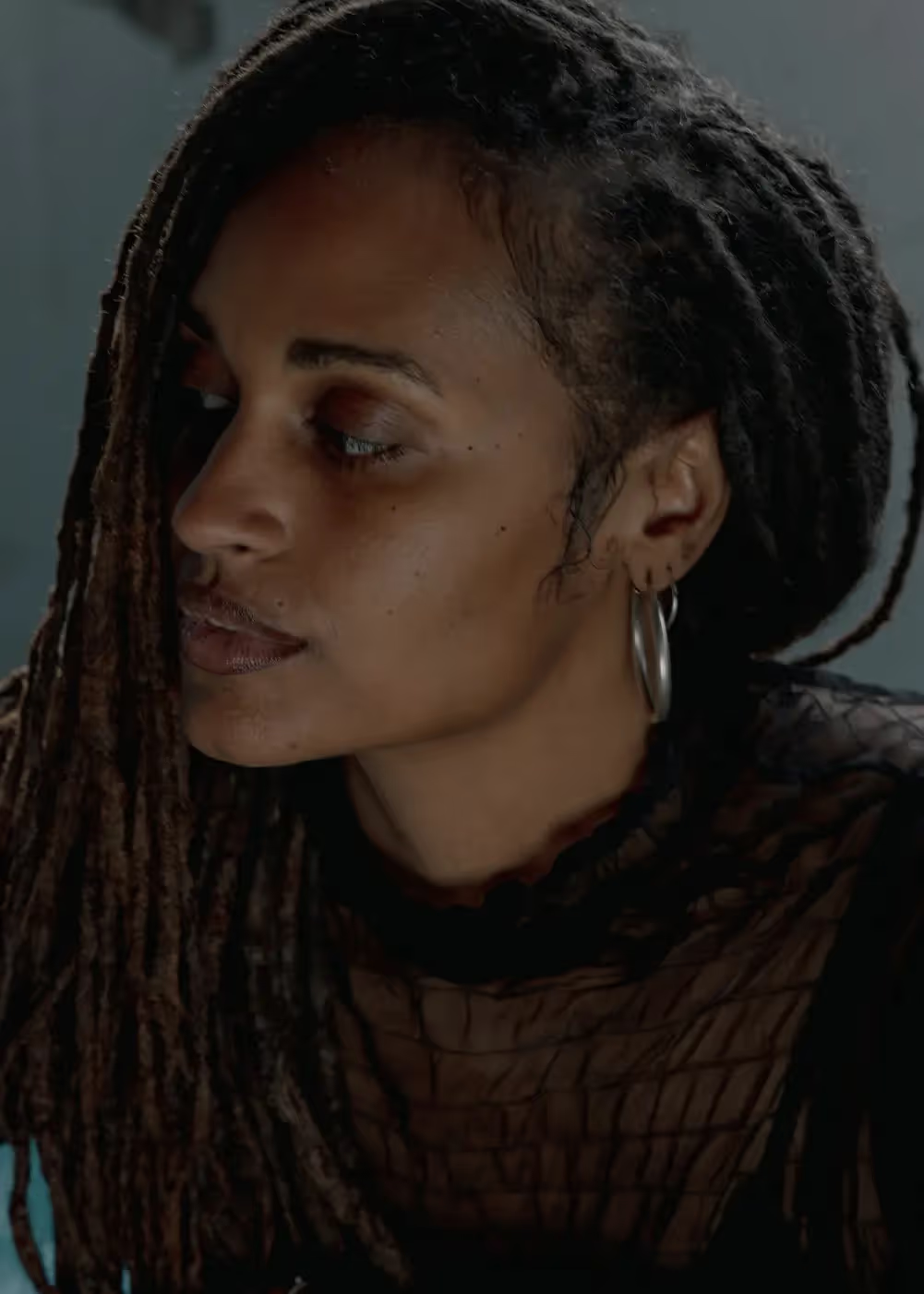
Senegalese-Spanish artist Maguette Dieng embodies this ideal. Based in Barcelona, she DJs and produces as MBODJ (pronounced em-bodge), but also curates, educates, and promotes both solo and with Jokkoo, the afro-diasporic collective she co-founded in 2017.
Championing artists from Africa and the African diaspora alongside leftfield sonics from around the world, her sets embrace fragility, complexity and the tension of transitions: from gqom and jungle and footwork to noise. Although she’s played everywhere from Mutek and Sónar to Boiler Room and Nyege Nyege in Uganda, her most crucial contributions have been local. With Jokkoo, she’s created critical alternative spaces for underground culture in the city, bringing radical artists from around the world to Barcelona and providing a place for local artists to develop.