
.webp)
.avif)


Pulso y Horizonte (Pulse and Horizon)
“Pulso y Horizonte” is an instrumental project led by Pedro Javier González, one of the most respected guitarists on the contemporary Spanish music scene. Flamenco, jazz, world music and improvisation converge in an open, celebratory proposal inspired by the Mediterranean, where rhythmic pulse and collective dialogue shape a vibrant and highly communicative musical experience.

Dates and times
Saturday, March 28, 5:30 p.m. to 6:30 p.m.

Address
Moll de Barcelona, Port Vell (Port of Barcelona). Scene.
“Pulso y Horizonte” is an instrumental project led by Pedro Javier González, one of the most versatile and respected guitarists and composers on the contemporary Spanish music scene. Conceived as a space for artistic synthesis, the project brings together decades of musical exploration in an open, rhythmic and celebratory proposal where flamenco, jazz, world music and improvisation converge from a distinctly Mediterranean perspective.
Born in Barcelona in 1962, Pedro Javier González has developed a personal musical language defined by precision, balance and deep sensitivity. His background combines strong flamenco roots with a solid connection to jazz and improvisation. Early collaborations with leading figures of the Spanish music scene helped shape a broad and rigorous artistic vision.
In 1990 he joined El Último de la Fila as guitarist, a decisive collaboration that placed him at the forefront of the Spanish music panorama. Alongside this, he developed personal projects and an extensive recording career, collaborating with major national and international artists.
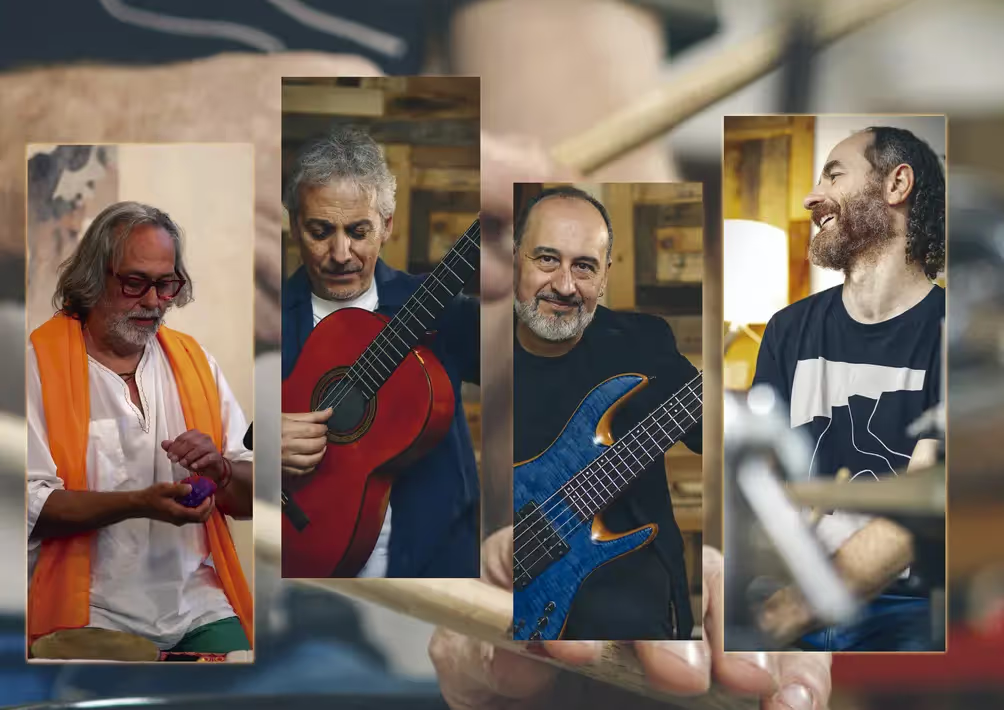
This artistic journey naturally crystallizes in Pulso y Horizonte, a project built around compositions from Callejón del gato and Sami Samay. The interaction between flamenco guitar, bass, drums and double percussion creates a vibrant and flexible musical language, where tradition and contemporaneity coexist and improvisation acts as a central creative force.
.avif)
Andreu Pimentel
Pedro Javier Gonzalez
Pedro Javier González – flamenco guitar (Barcelona, 1962) is one of the most versatile and respected guitarists and composers on the contemporary Spanish music scene. His playing style, defined by balance, precision and deep sensitivity, naturally blends flamenco, jazz and other musical languages, shaping a distinctive and immediately recognizable artistic voice.
He trained with masters such as Juan Trilla and Antonio Francisco Serra, who decisively shaped his flamenco roots, as well as Albert Cubero and Sean Levitt, who strengthened his connection to jazz and improvisation. He began his professional career alongside key figures of Catalan music such as Toti Soler, Ovidi Montllor and Feliu Gasull, developing a broad and rigorous musical vision.
In 1990 he joined El Último de la Fila as guitarist, a decisive collaboration that placed him at the forefront of the Spanish music scene through recordings and extensive tours. At the same time, he developed personal projects such as the duo Arrebato with singer Rafael Maya, releasing Rumba canalla (EMI, 1992).
Throughout his career he has released fourteen albums under his own name and worked as a session musician on hundreds of recordings with leading artists, while also sharing stages and festivals with major international figures across genres. His discography combines original compositions with acoustic reinterpretations and instrumental projects, reflecting a constant search for balance between tradition and contemporaneity.
Instagram Pedro Javier González
Antonio Sánchez Barranco
Antonio Sánchez Barranco – percussion (Barcelona, 1969) is a percussionist and sound creator with a solid and wide-ranging career spanning flamenco, traditional music, improvisation and contemporary creation. His work is characterized by an open conception of rhythm, where technical precision coexists with a constant exploration of timbre, texture and collective forms of expression.
He began his training in Latin percussion at the Taller de Músics in Barcelona and at Espai Avinyó, and later completed his studies at the Escola de Música Moderna de Badalona, where he developed a comprehensive view of percussion. His artistic development was profoundly influenced by his work with master percussionist Miguel “Angá” Díaz, who decisively shaped his technique, musicality and understanding of rhythm as an expressive language.
A key moment in his career was his work in sound research with the percussion group Tactequeté, which led him to explore rhythmic languages from Brazil, Africa and the Caribbean, as well as to develop a creative practice based on traditional and non-conventional instruments. His later collaboration with Eliseo Parra marked a deep engagement with the oral musical traditions of the Iberian Peninsula, a path that crystallized notably in the project Coetus, the percussion orchestra directed by Aleix Tobías, a leading reference in the contemporary reinterpretation of Iberian musical heritage.
Throughout his career, he has combined live performance with significant pedagogical activity and participation in theatre, dance and audiovisual productions, as well as an extensive discography.
Andreu Pimentel
Javier Martin
Javier Martín – bass (Viladecans, 1972) is a bassist, composer, arranger, producer and music educator with an extensive and well-established career in the contemporary music scene. He holds a Higher Degree in Jazz from ESMUC and the Taller de Músics in Barcelona, and has completed advanced studies in technique and harmony, as well as specific flamenco training with Carles Benavent, a key influence in his musical development.
His career is closely linked to the band Ojos de Brujo, of which he was a member and composer, taking part in several world tours and in a highly successful international artistic trajectory. With this group, he received major awards, including a Latin Grammy for the album Techarí, the Spanish Music Academy Award for Best Tour, and several BBC World Music Awards, establishing himself as a significant figure in the field of fusion music.
Throughout his career, he has collaborated as a live and studio musician with a wide range of leading artists, moving naturally between flamenco, pop, jazz and world music. His collaborations include work with Manolo García, Duquende, Peret, Maria del Mar Bonet, Miguel Poveda, Marc Parrot, Gerard Quintana, Sisa, Roger Mas, Pedro Javier González, Chicuelo and Jackson Browne, among many others, contributing to an extensive discography as well as stage and audiovisual productions.
Alongside his performance activity, he has developed an ongoing career as a producer, composer and arranger, as well as a strong pedagogical commitment through teaching in music schools, masterclasses and specialized programs. He currently leads his own project SAIO, a jazz-fusion band.
Martí Soler
Martí Soler – drums (Gavà, Barcelona, 1978) is a drummer and percussionist with a broad and versatile career spanning popular music, jazz, musical theatre and contemporary stage creation. His profile stands out for strong stylistic adaptability and solid experience both in live performance contexts and in large-scale stage productions.
He trained at the Taller de Músics in Barcelona and completed specialized drum studies at Drumtech (London), as well as private lessons with musicians such as Toni Pagès and Quim Solé. In parallel, he trained in drum circle dynamics with Arthur Hull, enriching his conception of rhythm as a tool for collective cohesion and community expression.
Throughout his career, he has taken part in numerous musical theatre productions, including Hair, Cabaret, The Addams Family, The Producers, Priscilla, Queen of the Desert, Grease and Tootsie, as well as television programs and live galas for networks such as TV3 and Antena 3. In the field of concerts and tours, he has performed with a wide range of ensembles and artists, including international tours, long-running residencies in leading venues and stage projects with sustained activity.
Alongside his artistic activity, he has developed extensive pedagogical work for over twenty-five years as a drum and percussion teacher, both in music schools and in private instruction. For the past fifteen years, he has directed a batucada school in Gavà and leads percussion workshops for schools and companies.
.webp)
Andreu Pimentel
