.webp)


"Mediterranean Tales", a conversation between Anne-Lise Broyer, Mohammed Bennis and Stéphanie Gaou
A conversation between artist Anne Lise Broyer and author Mohammed Bennis, moderated by Stéphanie Gaou, on the relationship between images and languages of the Mediterranean. Organized in conjunction with Anne Lise Broyer's exhibition "Was this where we lived?" at the Galerie Delacroix of the French Institute in Tangier.

Dates and times
Thursday, September 26, 16:30 to 18:00

Address
Port of Tangier - Opposite Bab El Marsa, Tangier, Morocco
"If my language is dying on earth, it means that it remains the only legacy that makes me wonder about its future. The enthusiasm that guided our steps in the 1970s in the direction of choosing between the West and the East has lost its vigor. Being Moroccan and writing in Arabic in no way separates me from other poets. Poetry stands alone, because it never ceases to attract the embers of languages. This is what the current condition of poetry teaches us. On Moroccan soil, it's not only poetry that is cut off from its vital environment, but also the Arabic-speaking poet, who remains an eternal stranger; there is no sign of hospitality on his path, no right to speak, for failing to love my language madly, and with which I never cease to write the song of funerals", from a text by Mohamed Bennis, translated by Maati Kabbal (Le Magazine littéraire, April 1999).
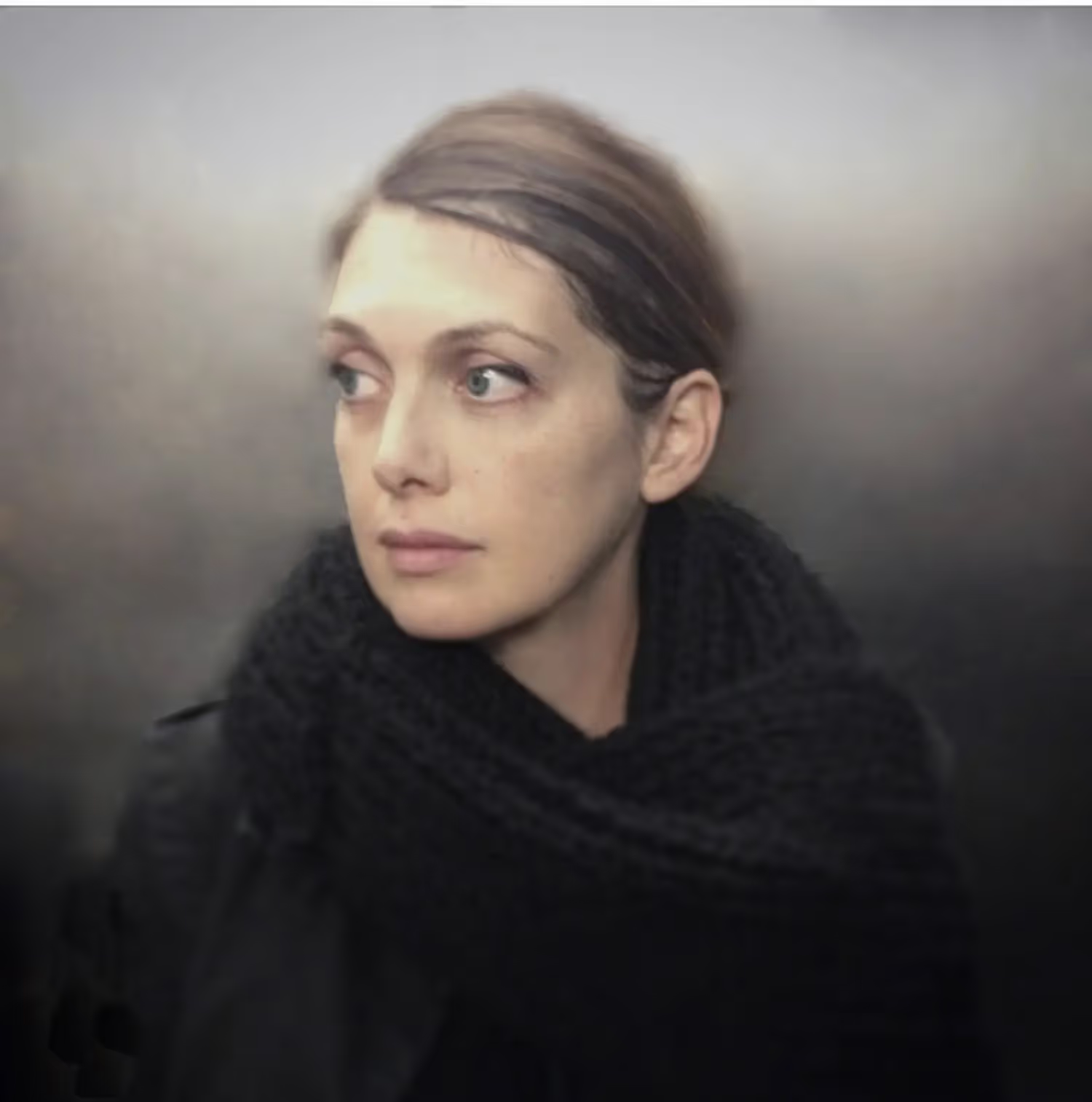
Anne-Lise Broyer
For over 20 years, Anne-Lise Broyer has pursued a singular photographic practice that can be summed up as an experience of literature through the eyes, intimately intertwining reading and the emergence of an image, writing and photography, as evidenced by the numerous editions she has shared with Pierre Michon, Bernard Noël, Colette Fellous, Yannick Haenel, Jean-Luc Nancy.... She also questions the areas of friction and intersection between silver photography and graphite drawings directly on the print, in order to achieve a zone of disturbance in perception. Anne-Lise Broyer thus creates visual situations that continually refer back to the photographic image and its technical history.
Mohammed Benni
Mohammed Bennis, born in 1948 in Fez, is a Moroccan poet, publisher and academic. He has published numerous collections in Arabic and several works translated into French, including "Le Don du vide" and "Funérailles entre deux fleuves". Co-founder of Editions Toubkal in 1985, Bennis teaches at Rabat University. A leading figure of modern poetry in Morocco, he draws his inspiration from Arab culture and French poetry.
Stéphanie Gaou
Stéphanie Gaou, born in Cannes, has lived in Tangier since 2004, the land she chose to write, open a bookshop & melt into her second nature. She regularly organizes large-scale cultural events in the city of Detroit. She has published poems and short stories with L'Harmattan & géhess, and a long narrative-poem with Al Manar, Capiteuses, in 2012 and Staccato in 2016 with the same publisher. She is a regular contributor to short films and artists' books.
Gallery

The artists