.webp)
.avif)
.avif)


A History of Cyprus through Its Animals: Introductions, Extinctions, Interactions, and Depictions in Ancient Art
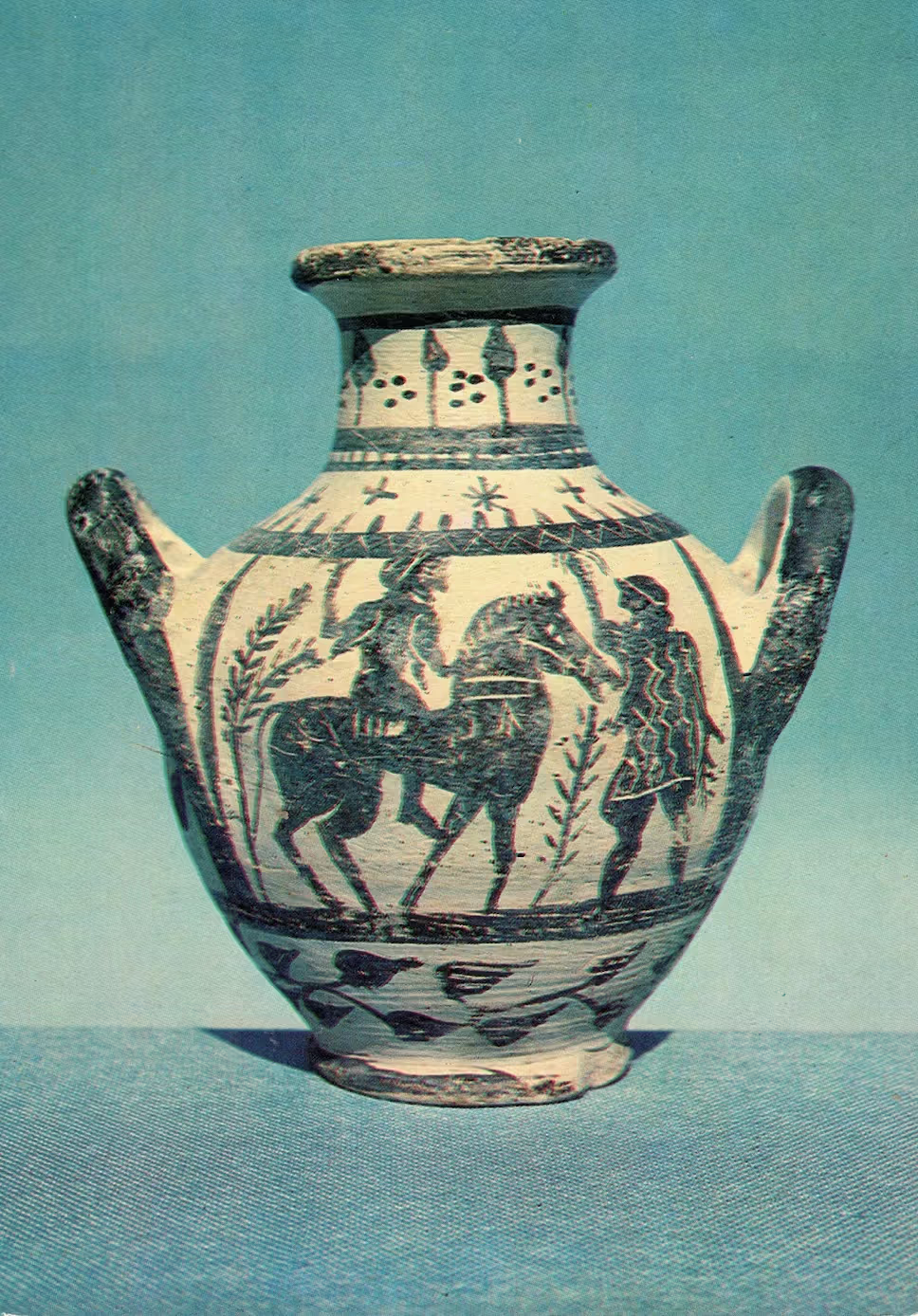
The story of humans and animals in Cyprus is long, complex, and intriguing. There were multiple cases of introduction, extinction and endless forms of interactions between animals and humans, all the way to the modern day. Join an interactive journey with many stops through time. Explore and discuss the extinction of Cyprus’ endemic fauna, the introductions of wild and domestic animals, their changing roles through time, later extinctions, their presence in ancient art and many more. As the museum exhibits illustrate, the history and art of Cyprus is greatly enriched by the human fascination with animals. In parallel αnd throughout the day the film Secret will be screened in loop at the museum.


Dates and times
Tuesday, November 4: 17:00 - 18:30 (English) and 19:30 - 21:00 (Greek)

Address
Limassol Archaeological Museum, Anastasi Sioukri, Lemesos 3035, Cyprus

Accessibility
Ages 15 and up. The museum is wheelchair accessible. Access by ramp and elevator. There are wheelchair-accessible toilets. No wheelchair-accessible parking spaces.
This event is a journey through time at the Archaeological Museum of the Lemesos District. In this journey, participants can explore the endless aspects of the diachronic human-animal relationship in Cyprus. This relationship began about 12000 years ago with the human colonisation of Cyprus and the introduction of the first animal species (a wild pig) from continental areas around Cyprus.
Since the arrival of humans to Cyprus, the human-animal relationship has diversified and all of its aspects have been under constant re-negotiation through time. The animal-related exhibits of the Museum provide us the opportunity to think, wonder, ask, discuss and re-imagine the fascination of ancient people with animals.
Among other little-known subjects to be discussed are:
- Which animals were introduced to Cyprus and how did they shape its environment?
- When and why did people domesticate animals?
- When and how did different species go extinct in Cyprus?
- How were animals used in the economy, social relations and religion?
- What can the past of the human-animal relationship teach us about the present and future?
Angelos Hadjikoumis
Angelos Hadjikoumis is a researcher at The Science and Technology in Archaeology and Culture Research Center (STARC) of The Cyprus Institute. He specializes in Zooarchaeology, which involves the study of animal remains recovered from archaeological sites in order to explore human-animal relations in the past. He studied History/Archaeology at the University of Athens, Environmental Archaeology and Zooarchaeology at the University of Sheffield. His research focuses on the finds of the eastern Mediterranean and neighboring regions such as the Aegean and Mesopotamia, as well as the Iberian Peninsula and Britain. He is particularly interested in sheep and goat management, the use of animals in rituals, and animal husbandry from the Neolithic period to more recent times. His methods include stable isotope analysis and dental microwear analysis. He is also engaged with the ethnography of traditional Mediterranean pastoralism and is an advocate of public outreach in archaeology.
Yiannis Violaris
Yiannis Violaris studied Accounting and Economics at the University of Reading, England and Archaeology and History at the Aristotle University of Thessaloniki. He holds a master’s degree in the History and Critique of Arts from the University of Rennes 2, France. He is employed at the Department of Antiquities, Cyprus as an Αrchaeological Οfficer and he is based at the Archaeological Museum of the Lemesos District. Among other things, he directs excavations, curates exhibitions, gives lectures and he is responsible for the Archaeological Site of Amathus. His research interests include the ancient kingdom of Amathus, the topography of byzantine and medieval Nicosia and Limassol, byzantine and medieval glazed pottery, the modern pottery of Cyprus (18th-20th c.) and the history of archaeology in Greece and Cyprus. Lately, he is interested in the way archaeology is perceived by modern art and literature and within this framework he publishes papers and curates exhibitions of modern art in archaeological museums or archaeological sites, where works of modern art are exhibited in dialogue with antiquities. His research interests also include ethnography and the history of modern Greek literature.

The artists
